







You will visit the most beautiful points of interest in Arlon

Arlon in 48 hours: two days to feel the city
Arlon has this human pace where every street corner invites a stroll. Starting from the Arlon Town Hall and ending at the Gaspar Museum, this two-day itinerary is designed so you take time to observe, ask locals questions, and intentionally get lost in the small streets. You will alternate historical sites, gourmand stops and moments of reflection in places like the Old Cemetery and Roman Baths.
The typical day begins with a walking exploration of the center: the Saint-Donat Church and the Old Courthouse form a small cultural triangle with the memorial of the M10 Tank Destroyer. These places, close to each other, are discovered without hurry, at a time when the light highlights the façades and the textures of the stone. You will feel the mix of intimacy and history that gives Arlon its charm.
The afternoons are made for wandering, savoring the local cuisine — perhaps in a convivial pizzeria like the Hotel Pizzeria Trulli — and visiting a museum on a human scale. The route naturally brings you back to the Arlon Police and, depending on your pace, to other corners to explore. The aim is not to rush from stop to stop, but to let each place speak to you.
Over the course of the two days, you will have time to appreciate the proximity of the sites, the simplicity of getting around and the possibility of tailoring the itinerary to your desires. This guide provides the through-line: practical landmarks, accommodation recommendations, culinary tips and extras (including Coddy's urban escape games) to enrich your stay.
Quick guide — Two days in Arlon
Day 1: Morning devoted to the historic heart. Start at the Arlon Town Hall, then head to the Saint-Donat Church and the Old Courthouse. Take a break to observe the M10 Tank Destroyer and finish the morning at the Old Cemetery and Roman Baths. Quiet afternoon: a stop at the Arlon Police as an orientation landmark, a lunch at the Hotel Pizzeria Trulli, then a visit to the Gaspar Museum.
Day 2: Pick up the thread again to deepen what you enjoyed on day one — head back to the center, revisit an exhibition or slow down in a cafe. Use the morning to see the monuments in a different light. The afternoon could be devoted to a longer museum visit, local craft shopping or a playful experience, such as Coddy's urban escape games, to see the city from another angle.
This plan is deliberately flexible: distances are short, most sites are walkable and the pace depends entirely on your curiosity. Bring good shoes and plan coffee breaks between each stop.
Day 1
8 stops
Morning
-
1
Arlon City Hall
45 min
- This building was built in 1842-1843, according to the plans of architect A.
- Jamot, to house the Royal Athenaeum of Arlon.
- A few years later (1884), it became the boarding school of the Athénée.
- It was in 1898 that the municipal administration settled definitively in these premises.
- Over the years, the building underwent several interior improvements.
- But in 1918 it was subjected to a major bombing, which devastated its right wing.
- Its restoration took several years.
- Starting in 1967, the area surrounding the town hall was urbanized, following the demolition of the surrounding houses.
- The merger of the municipalities (1976) led to the expansion of municipal services.
- The new wing was inaugurated in 1997.
- Paul Reuter Street is a tribute to the burgomaster who, during the two world wars, showed resistance to the invaders.
Coddy games passing through
-
2
Former courthouse
45 min
- The Palace of Justice in Arlon, built from 1864 was designed by architect Albert-Jean-Baptiste Jamot.
- Neo-Gothic in style, the building consists of a main body with three levels and two lower wings, accessed through an imposing double-flight staircase leading to three pointed-arch doors.
- Stone-carved coats of arms of the ten main cities of the province adorn the building between the first-floor lintels and second-floor windows.
- Originally housing the Luxembourg Assize Court and the Court of First Instance, all judicial services moved to the new Palace of Justice in Arlon in April 2003.
- Since 2013, the old Palace of Justice has been repurposed as a cultural space, hosting prestigious temporary exhibitions, conferences, and musical events.
- In 1908, the International Congress for the Culture and Expansion of the French Language took place at the Palace of Justice in Arlon, advocating for the promotion of the French language and culture, with sections dedicated to literature, propaganda, and pedagogy.
Coddy games passing through
-
3
St. Donatus' Church
Landmark · 45 min
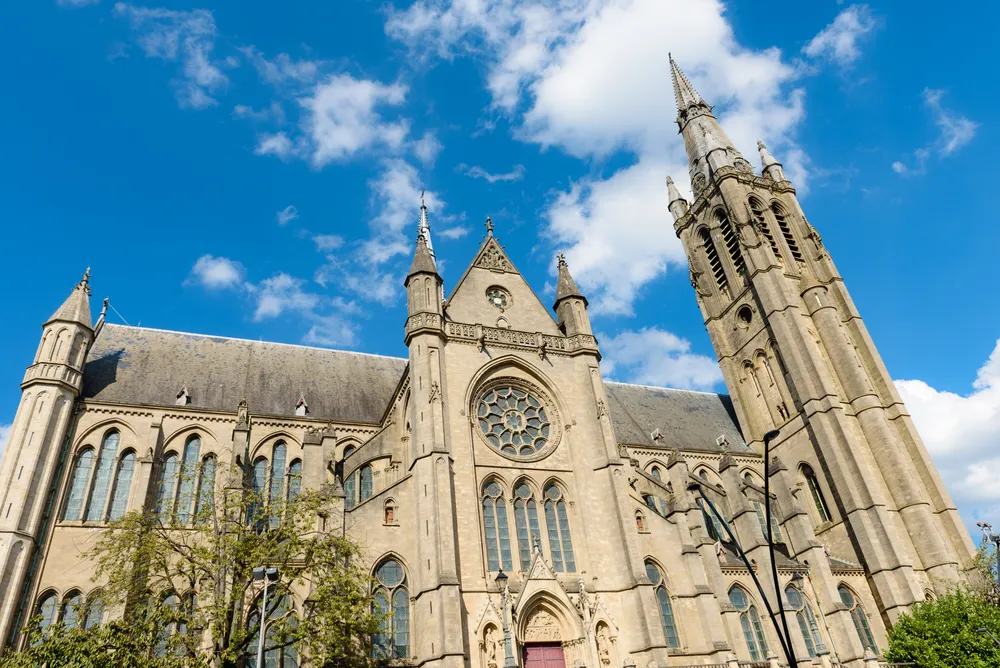
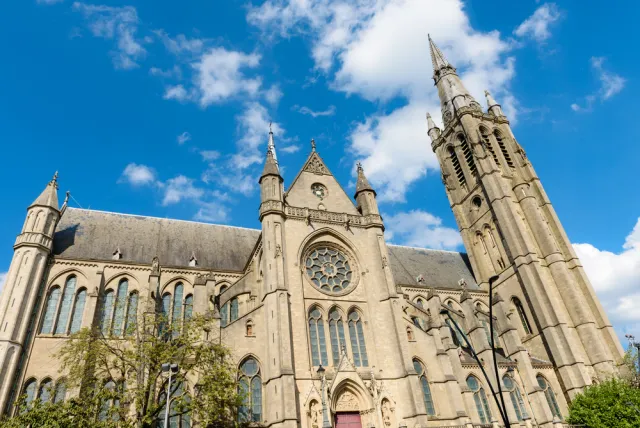
- The Sint-Donatuskerk is situated on the Knippchen, a central hill in Arlon, Belgium, historically used by the Gallo-Roman population as an impregnable site during the Great Migrations (269-270). Built between 1621 and 1626 by the Capuchins on the ruins of a castle destroyed in 1558, it was fortified under Louis XIV's rule and later restored in 1851 and at the end of the 19th century. The church holds a significant piece of local culture, featuring the Chemin royal de la Croix, a stone cross route leading to the church and serving as an important heritage site.
- It offers a panoramic view of Belgium, the Grand Duchy of Luxembourg, and France from its tower. The church's carillon plays the tune "Zu Arel op der Knippchen," a traditional folk song of the Land of Arlon and the Grand Duchy of Luxembourg, serving as the unofficial hymn of the Belgian province of Luxembourg. The Belvédère, a 35m high tower constructed between 1905 and 1907, replaces the original Capuchin bell tower and has become a notable symbol of the city, offering a panoramic view from its open-air gallery.
© Wikimedia Commons
Coddy games passing through
-
4
Old cemetery and Roman baths
Historic · 1h
- The old communal cemetery has been disused since 1852.
- However, it still contains many crosses from the 17th, 18th and 19th centuries.This site has been occupied since Roman times: the remains of thermal baths and a hypocaust (heating) have been found.
- Next to it, a building of Roman origin, but of undetermined function, served as a burial place in the 6th and 7th centuries.21 graves from the Merovingian period were excavated.
- A Romanesque church, dedicated to Saint Martin, was built on the foundations of this building in the 13th century, where it lasted for three centuries.On its ruins, a chapel with a hermitage was built (17th century).
- Abandoned, the chapel was destroyed in 1878.
Coddy games passing through
-
5
M10 Tank Destroyer
Historic · 45 min
- This memorial was erected on the occasion of the 40th anniversary of the liberation of Arlon, inaugurated on 24 September 1984.The centerpiece is an M10 tank destroyer, an armored vehicle derived from the famous Sherman.
- It is decorated with the markings of the 630th Tank Destroyer Bn. whose A Company was assigned to Task Force Strickler (28th Infantry Division) for its missions that led to the liberation of Arlon.The second element is a stele made of old street cobblestones, bearing a bronze plaque recalling the liberation of Arlon by American forces.
© Wikimedia Commons
Coddy games passing through


Afternoon
-
6
Arlon Police Station
45 min
Coddy games passing through
-
7
Gaspar Museum
45 min
- Push open the door of this luxurious 19th century residence to meet Jean and Charles Gaspar, two brothers, one a sculptor, the other a pictorialist photographer and patron.The vigorous and realistic animals of Jean, a pupil of Jef Lambeaux, stand side by side with the softer and more timeless photographs of Charles.The museum also organizes important temporary exhibitions thanks to its very rich collections.At the end of the tour, you will discover the exceptional Antwerp altarpiece known as the Fisenne altarpiece, dating from the early 16th century, alongside other collections of religious art.
Coddy games passing through
-
8
Hotel Pizzeria Trulli
45 min
Day 2
8 stops
Morning
-
9
Arlon City Hall
45 min
- This building was built in 1842-1843, according to the plans of architect A.
- Jamot, to house the Royal Athenaeum of Arlon.
- A few years later (1884), it became the boarding school of the Athénée.
- It was in 1898 that the municipal administration settled definitively in these premises.
- Over the years, the building underwent several interior improvements.
- But in 1918 it was subjected to a major bombing, which devastated its right wing.
- Its restoration took several years.
- Starting in 1967, the area surrounding the town hall was urbanized, following the demolition of the surrounding houses.
- The merger of the municipalities (1976) led to the expansion of municipal services.
- The new wing was inaugurated in 1997.
- Paul Reuter Street is a tribute to the burgomaster who, during the two world wars, showed resistance to the invaders.
Coddy games passing through
-
10
Former courthouse
45 min
- The Palace of Justice in Arlon, built from 1864 was designed by architect Albert-Jean-Baptiste Jamot.
- Neo-Gothic in style, the building consists of a main body with three levels and two lower wings, accessed through an imposing double-flight staircase leading to three pointed-arch doors.
- Stone-carved coats of arms of the ten main cities of the province adorn the building between the first-floor lintels and second-floor windows.
- Originally housing the Luxembourg Assize Court and the Court of First Instance, all judicial services moved to the new Palace of Justice in Arlon in April 2003.
- Since 2013, the old Palace of Justice has been repurposed as a cultural space, hosting prestigious temporary exhibitions, conferences, and musical events.
- In 1908, the International Congress for the Culture and Expansion of the French Language took place at the Palace of Justice in Arlon, advocating for the promotion of the French language and culture, with sections dedicated to literature, propaganda, and pedagogy.
Coddy games passing through
-
11
St. Donatus' Church
Landmark · 45 min
- The Sint-Donatuskerk is situated on the Knippchen, a central hill in Arlon, Belgium, historically used by the Gallo-Roman population as an impregnable site during the Great Migrations (269-270). Built between 1621 and 1626 by the Capuchins on the ruins of a castle destroyed in 1558, it was fortified under Louis XIV's rule and later restored in 1851 and at the end of the 19th century. The church holds a significant piece of local culture, featuring the Chemin royal de la Croix, a stone cross route leading to the church and serving as an important heritage site.
- It offers a panoramic view of Belgium, the Grand Duchy of Luxembourg, and France from its tower. The church's carillon plays the tune "Zu Arel op der Knippchen," a traditional folk song of the Land of Arlon and the Grand Duchy of Luxembourg, serving as the unofficial hymn of the Belgian province of Luxembourg. The Belvédère, a 35m high tower constructed between 1905 and 1907, replaces the original Capuchin bell tower and has become a notable symbol of the city, offering a panoramic view from its open-air gallery.
© Wikimedia Commons
Coddy games passing through
-
12
Old cemetery and Roman baths
Historic · 1h
- The old communal cemetery has been disused since 1852.
- However, it still contains many crosses from the 17th, 18th and 19th centuries.This site has been occupied since Roman times: the remains of thermal baths and a hypocaust (heating) have been found.
- Next to it, a building of Roman origin, but of undetermined function, served as a burial place in the 6th and 7th centuries.21 graves from the Merovingian period were excavated.
- A Romanesque church, dedicated to Saint Martin, was built on the foundations of this building in the 13th century, where it lasted for three centuries.On its ruins, a chapel with a hermitage was built (17th century).
- Abandoned, the chapel was destroyed in 1878.
Coddy games passing through
-
13
M10 Tank Destroyer
Historic · 45 min
- This memorial was erected on the occasion of the 40th anniversary of the liberation of Arlon, inaugurated on 24 September 1984.The centerpiece is an M10 tank destroyer, an armored vehicle derived from the famous Sherman.
- It is decorated with the markings of the 630th Tank Destroyer Bn. whose A Company was assigned to Task Force Strickler (28th Infantry Division) for its missions that led to the liberation of Arlon.The second element is a stele made of old street cobblestones, bearing a bronze plaque recalling the liberation of Arlon by American forces.
© Wikimedia Commons
Coddy games passing through
Afternoon
-
14
Arlon Police Station
45 min
Coddy games passing through
-
15
Gaspar Museum
45 min
- Push open the door of this luxurious 19th century residence to meet Jean and Charles Gaspar, two brothers, one a sculptor, the other a pictorialist photographer and patron.The vigorous and realistic animals of Jean, a pupil of Jef Lambeaux, stand side by side with the softer and more timeless photographs of Charles.The museum also organizes important temporary exhibitions thanks to its very rich collections.At the end of the tour, you will discover the exceptional Antwerp altarpiece known as the Fisenne altarpiece, dating from the early 16th century, alongside other collections of religious art.
Coddy games passing through
-
16
Hotel Pizzeria Trulli
45 min
Practical details for visiting Arlon
Where to stay
For a practical stay, focus on the city center around the Arlon Town Hall: you will be within walking distance of most of the listed sites. The neighborhoods near the center offer a good balance between accessibility and local atmosphere. If you prefer quiet, look for accommodation slightly on the outskirts and enjoy a short morning walk. In terms of accommodation types, consider small hotels, bed and breakfasts, and rental apartments that often provide a more personal touch to local life. For budgets, average prices vary by season: expect economical options for price-conscious travelers, mid-range deals for a comfortable stay, and a few addresses that are more comfortable for a nicer stay. Booking early gives access to the best rooms, especially if you travel during a busy weekend.
Getting around
Arlon lends itself particularly well to walking: the center is compact and most sites are close to one another. For longer trips, consider local services such as regional buses and taxis. Bike rental is a nice option to stay mobile while enjoying the scenery; check with local shops that offer bikes for the day. If you have limited time, favor taxi trips to save time between two appointments. Plan regular breaks: walking slowly will allow you to notice details you miss when you go too fast. Always keep a paper map or offline copy of your itinerary in case the mobile network is uncertain.
What to bring
Consider the season but keep it simple: comfortable shoes for pavements and walking, a light raincoat or windbreaker for sudden showers, and a warm layer for cooler evenings. If you plan visits to places of remembrance, a modest outfit is useful. Bring a small daypack, a reusable water bottle and portable chargers for your devices. For photography, a compact camera or your smartphone will do: architectural details are often more interesting than distant panoramas. Prioritize practicality over gear excess.
Advance reservations
Book your accommodation in advance if you come on a weekend or during busier local periods. For popular restaurants like the Hotel Pizzeria Trulli, it's wise to reserve a table, especially in the evening. If you plan to visit a temporary exhibition at the Gaspar Museum or attend a local event, check whether skip-the-line tickets are required. For guided activities or experiences (themed tours, workshops), consider booking several days ahead to secure your place. Finally, if you want to try an urban escape game, especially Coddy's, book online: these experiences can fill up quickly.
Extras not to miss
Besides the main itinerary, treat yourself to a few detours to enrich your stay: a slow stroll through less touristy streets, a break in an artisan cafe, or a look at local shop windows. Do not miss the memorial of the M10 Tank Destroyer for a moment of contemplation and reflection. For a playful and original activity, try Coddy's urban escape games: they let you roam the city by solving puzzles and offer a different perspective on the urban fabric. If you love architecture, take time to observe the façades and details of public buildings like the Old Courthouse. Finally, a mini shopping session with local artisans will let you bring back something authentic.
Local delights
Arlon's cuisine deserves to be savored slowly. Favor friendly spots like the Hotel Pizzeria Trulli for a tasty and simple break. Look for menus featuring seasonal produce and regional specialties at small restaurants. For lovers of sweets, stop at a local bakery or have a coffee on a terrace to observe daily life. Markets, when they take place, are excellent places to feel the atmosphere and discover fresh products: cheeses, breads and artisanal goods. Finally, let locals' recommendations guide you to less touristy and more authentic addresses.
When to visit Arlon and how much it costs
Best seasons
Spring and autumn often offer the best compromise between pleasant weather and reasonable crowds: walks are more comfortable and the light is nice for photos. Summer brings long days and livelier street life, ideal if you enjoy the terrace atmosphere, but expect higher prices and busier places. Winter offers another atmosphere, more intimate and quiet, suited to visitors who love museums and warm cafes. Each season has its charm: favor spring for mildness, summer for liveliness, autumn for colors and winter for tranquility. Spring, Summer, Autumn and Winter thus offer different experiences depending on your preferences.
Crowds
Quiet periods (outside school holidays and local events) allow you to enjoy sites fully without queues. Conversely, weekends and holiday periods can attract more visitors, especially around museums and popular restaurants. To avoid crowds, plan visits early in the morning or late afternoon, and book key restaurants or activities in advance. If you prefer a calmer experience, choose weekdays for major visits and reserve afternoons for cafes and strolls. Crowds also influence accommodation prices: during peak times, rates rise, hence the value of booking early.
Estimated budget
- Budget travel
- <h3>Budget</h3><p>Economy budget: Plan for simple lodging options such as dorm rooms or small guesthouses, meals in affordable cafés or pizzerias like the Hotel Pizzeria Trulli, walking around, and perhaps one or two museum tickets. Budget a tight amount for extras but enough to enjoy the main attractions.</p>
- Mid-range budget
- <h3>Budget</h3><p>Mid-range budget: Include a mid-range hotel near the center, meals in restaurants of middling quality, the purchase of a few souvenirs, and participation in a guided activity or an urban escape game. This budget allows more flexibility for museums and evening outings.</p>
- Comfort budget
- <h3>Budget comfort</h3><p>Comfortable budget: Opt for a comfortable hotel or a neat bed and breakfast, meals in good restaurants, private guided tours and additional experiences (workshops, events). This level lets you approach the stay without time constraints and fully enjoy the extras.</p>
Frequently asked questions about your stay in Arlon
Last recommendations for enjoying Arlon
In two days, you'll have time to feel the soul of Arlon without rushing: focus on the quality of visits rather than quantity. Start each day at the Arlon Town Hall to get oriented, let yourself be surprised by the Saint-Donat Church and the Old Courthouse, take regular breaks and finish at the Gaspar Museum for a final moment of calm. Leave room for the unexpected: a storefront, a conversation with a shopkeeper, or a detour to a less-traveled neighborhood can make all the difference. Travel light and head home with the idea of returning if you liked the city.
If you enjoy mixing culture and play, don't forget to add Coddy's urban escape games to your program to see Arlon from a playful angle. Finally, note that the best way to take away a lasting memory is to take the time to listen to the places and their inhabitants: that's often where the most beautiful travel stories are born.