You will visit the most beautiful points of interest in Barcelona
2-day itinerary in Barcelona
If you have only two days to spend in Barcelona, this route takes you from the green avenues near the park to the heart of the Gothic Quarter, crossing modernist architecture and history-rich lanes. I designed this itinerary to balance walking, tasty breaks, and moments of contemplation, without rushing from one monument to another. You will start at the Castle of the Three Dragons and end at the majestic Cathedral of Saint Eulalia in Barcelona, crossing about twenty points of interest designed to give a real sense of the city.
The first day favors urban strolls and iconic squares: from the Arc de Triomf to the shopping boulevards, passing by museums and lively squares. The second day focuses on the great modernist wave: Gaudí’s façades to lesser-known modernist houses, ending in the medieval atmosphere of the old town. At each stop, leave room for the unexpected: a cafe, a terrace, or a craft shop can transform an ordinary visit into a lasting memory.
As you walk, you will encounter must-see places like the Plaça de Catalunya, Casa Batlló, La Rambla and La Boqueria, but also lesser-known treasures like Palau Marcet or the calm streets of the Born. I indicate logical breaks, alternatives if you’re pressed for time, and practical suggestions to maximize your time. This guide aims for a lively and authentic experience: feel the city, notice the details, and take the time to listen to the atmosphere.
Follow this plan at your own pace: it’s designed to be doable without exhausting you, while offering full immersion. A few practical tips and accommodation options will help you prepare the trip. Safe travels and enjoy every corner — Barcelona often reveals itself by walking.

Day-by-day summary
Day 1 — Morning: Start at the Castle of the Three Dragons to feel the park’s pulse, then head toward the Palace of Justice and the Arc de Triomf. Continue on Montcada Street to admire façades and galleries, and finish the morning with a stroll along Passeig del Born, perfect for a terrace coffee. Afternoon: Reach the Plaça de Catalunya to catch your breath, visit the Marcet Palace, then descend Avinguda del Portal de l’Àngel, stop at the Monastery of Santa Anna and finish at the Basilica of Santa Maria del Mar.
Day 2 — Morning: Dedicate the morning to Modernism. Start with Casa Batlló, then Casa Milà, Casa Enric Batlló and Casa Lleó Morera, taking time to observe the details of the façades and sculptural elements. End the morning at Plaça del Rei to dive into medieval history. Afternoon: Stroll toward the Palau de la Virreina, wander through the colorful stalls of La Boqueria, stroll down La Rambla, pause in front of the Palau de la Generalitat, and conclude your itinerary at the Cathedral of Saint Eulalia in Barcelona.
This pace leaves room for tasty breaks, a few optional museums, and detours according to your desires. Prepare good shoes and a small water reserve — the city is very walkable.
Day 1
10 stops
Morning
-
1
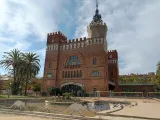
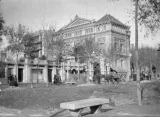
Castle of the Three Dragons
Historic architecture · 45 min
- The Castell dels Tres Dragons was built as a café-restaurant for the Barcelona Universal Exposition of 1888.
- Its architecture is modernist and eclectic: of exposed brick and laminated iron with ceramic decoration and stained glass.
- After being a main building of the Universal Exposition, it went through several museum functions and restorations.
- Its name, probably, was taken from Serafí Pitarra's satirical theatrical play of 1865.
© Wikimedia Commons
Coddy games passing through
-
2
Montcada Street
Squares · 45 min
- Montcada Street was opened in the 12th century by the Montcada family to connect the neighborhoods of La Bòria and La Ribera.
- Throughout the 14th to 18th centuries, the street housed numerous palaces, becoming an important bourgeois center.
- Today, the street is known for its civil Gothic architecture and is home to several restored palaces, including the Picasso Museum and the Maeght Gallery.
© Wikimedia Commons
Coddy games passing through
-
3
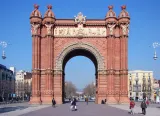
Barcelona's Arc de Triomf
Historic architecture · 15 min
- The Arc de Triomphe was the main entrance to the Universal Exposition of Barcelona in 1888. It has a civilian character and represents artistic, scientific and economic progress.
- Inspired by the neo-Mudejar style, it is 30 meters high and richly decorated with sculptures.
© Wikimedia Commons
Coddy games passing through
-
4
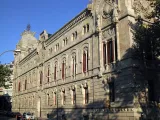
Palace of Justice of Barcelona
Historic architecture · 45 min
- The Palace of Justice of Barcelona was built between 1887 and 1908.
- The building presents an eclectic, monumental and grandiloquent style, with a certain classicist tendency. 22 reliefs and 48 sculptures representing figures related to law, history and culture were selected.
- The entrance door stands out for the sculptural group "Moses with the Tablets of the Law," the work of Agustín Querol.
- The interior decoration includes mural paintings, as well as a large number of sculptural works by outstanding sculptors of the time.
© Wikimedia Commons
Coddy games passing through
-
5
Passeig del Born
Squares · 45 min
- Passeig del Born is a historic promenade located that has been the scene of various events over the centuries. It connects the old Borne Market and the church of Santa Maria del Mar.
- Tournaments, festivals, fairs and other activities have been held since the thirteenth century.
- In the 16th century, those condemned by the Inquisition were executed.
- Most of the buildings were rebuilt or refurbished in the 18th and 19th centuries.
© Wikimedia Commons
Coddy games passing through

Afternoon
-
6
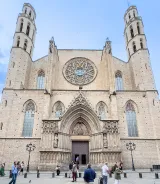
Basilica of Santa Maria del Mar
Religion · 30 min
- The Basilica of Santa Maria del Mar was built between 1329 and 1383. It is believed to have been built over an ancient Roman amphitheater.
- Its architectural style is purely Gothic: robust exterior with predominant horizontal lines, octagonal towers and massive buttresses.
- The interior has three naves with a sense of unique space and peculiar lighting.
© Wikimedia Commons
Coddy games passing through
-
7
Avinguda del Portal de l'Àngel
45 min
- Avinguda de la Porta de l'Àngel is a famous pedestrian thoroughfare in Barcelona known for its abundance of stores and cultural activities.
- In the early Middle Ages, this area was outside the Roman walls and was crossed by a stream.
- According to legend, an angel appeared in this place during the visit of Vicente Ferrer in 1419, which gave rise to the name.
- The name became official in 1466 at the initiative of King Pedro of Portugal, in gratitude for the end of a plague epidemic.
- For a long time, on October 2, a feast was held in honor of the angel and pomegranates were eaten, believing that they protected against diseases.
- Currently, there is an image of an angel on the Bank of Spain building, made in 1957 by Angel Ferrant.
- In this avenue is the fountain of Santa Ana, the oldest in Barcelona. Built in 1356, it began as a drinking trough for horses.
Coddy games passing through
-
8
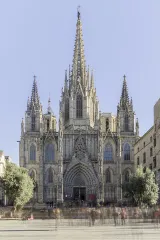
Cathedral of the Holy Cross and Saint Eulalia
Landmark · 45 min
- The Cathedral of Santa Cruz and Santa Eulalia (patron saint of the city) is an important Gothic monument of Barcelona.
- It was built between the 13th and 15th centuries.
- Thirteen white geese live in the cloister, in reference to Saint Eulalia: it is said that Eulalia was thirteen years old when she was executed and that she herded geese.
- The gargoyles represent various animals such as a lion, a unicorn or an elephant, among others.
- The basilica is located on a Paleochristian basilica and a Romanesque cathedral.
© Wikimedia Commons
Coddy games passing through
-
9
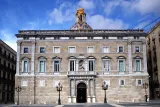
Palace of the Generalitat
Landmark · 45 min
- The Palace of the Generalitat de Catalunya is the seat of the Presidency of the Generalitat de Catalunya.
- It has undergone several extensions and renovations since its beginnings in 1400.
- To its Gothic architecture was added the Renaissance facade in 1596, being the first great facade of this architectural style in Catalonia.
- It has served as the headquarters of important institutions over the centuries and has witnessed key events in the history of Catalonia.
© Wikimedia Commons
Coddy games passing through
-
10
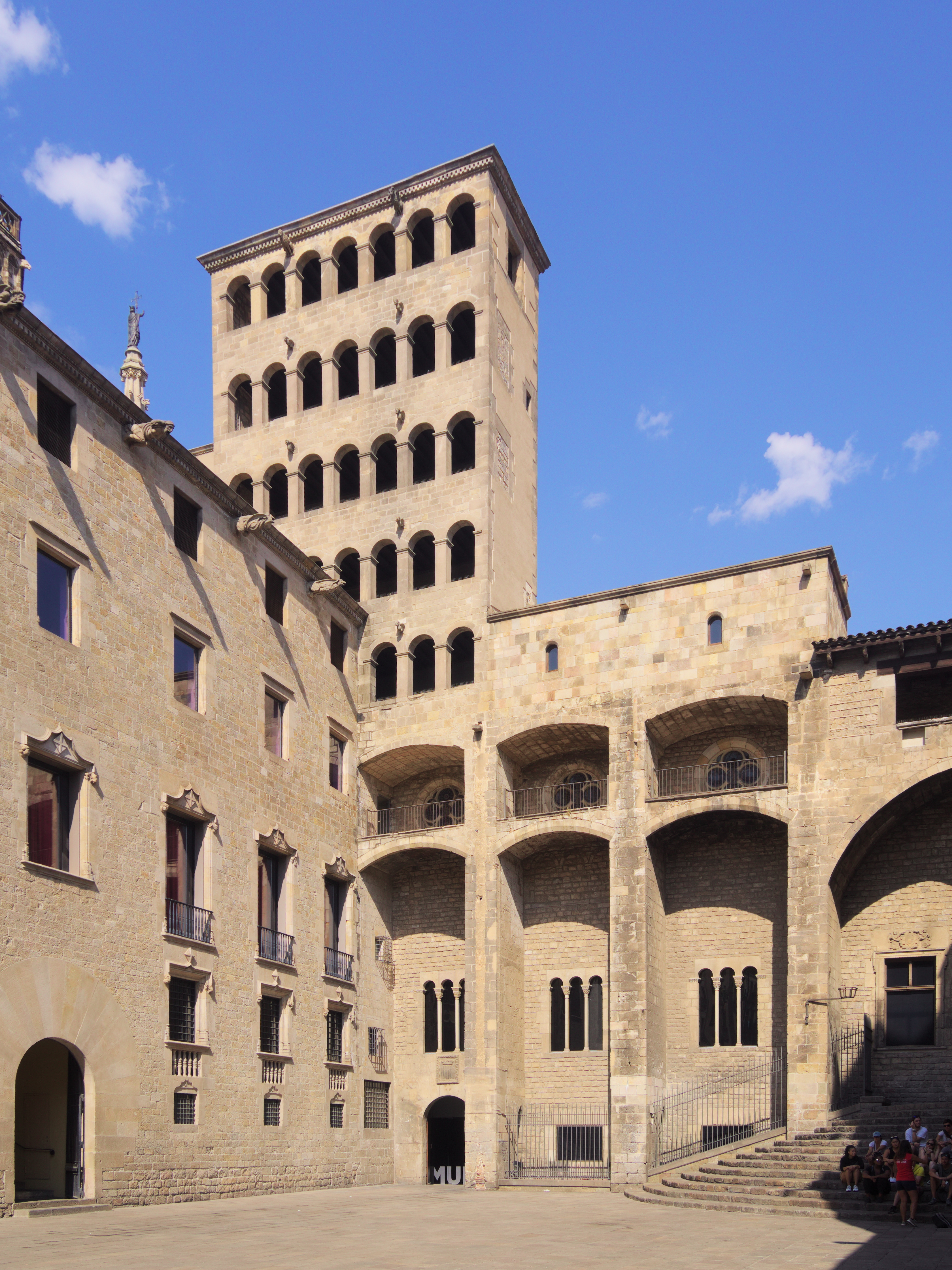
Plaça del Rei
Squares · 45 min
- The King's Square (Plaça del Rei) is a monumental square surrounded by Gothic and Renaissance buildings, including the main Royal Palace.
- In fact, the land that was developed in the 14th century to make the square was part of the courtyard of the royal palace. The square was used for centuries as a marketplace, even when it was still part of the palace.
- It was also the site of the first bullfight in Barcelona (1387).
- In 1492, King Ferdinand II of Aragon suffered an assassination attempt on the steps of the entrance to the Royal Palace Major.
- In the last century, important remains of the Roman city were discovered in the subsoil of the square, leading to the creation of the Barcelona Museum of History.
© Wikimedia Commons
Coddy games passing through
Day 2
10 stops
Morning
-
11
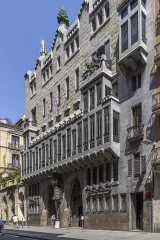
Palau Güell
Historic architecture · 45 min
- The Güell Palace was designed by Antoni Gaudí in Catalan modernist style.
- It was commissioned by Eusebio Güell, who admired Gaudí and financed several of his works.
- Gaudí put great effort into this work, his first major commission, devising up to twenty-five solutions for the façade.
- He collaborated with Francesc Berenguer, one of his faithful assistants, on the construction between 1886 and 1890.
- It belongs to Gaudí's Orientalist period (1883-1888), influenced by Oriental and Hispanic Islamic art.
- Gaudí used ceramic tile decoration, mitered arches, exposed brick cartouches and templete or dome-shaped finials.
© Wikimedia Commons
Coddy games passing through
-
12
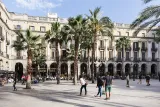
Plaça Reial
Squares · 45 min
- The Plaça Reial is a public square designed in neoclassical style in 1850 and is known for its unique design.
- It was conceived as a leisure center for the Barcelona bourgeoisie.
- In the center stands the Fountain of the Three Graces, with a circular pond and statues of the Charites.
- The lampposts were designed by Antoni Gaudí in 1879, with decoration including the coat of arms of Barcelona and the caduceus of Mercury.
© Wikimedia Commons
Coddy games passing through
-
13
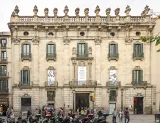
Virreina Palace
45 min
- The Palau de la Virreina is a Baroque palace on La Rambla used as the cultural headquarters of the City Hall.
- Built between 1772 and 1778 by Viceroy Manuel de Amat y Junyent, it is an outstanding example of Baroque civil architecture in Catalonia.
- The building houses temporary exhibitions and displays the Gegants de la Ciutat ("Giants of the City") and the Àliga ("Eagle") of Barcelona on a permanent basis.
- The façade features a symmetrical structure with balconies, Ionic pilasters and vases on the cornice.
- The interior courtyard has a double staircase and halls with windows decorated with pilasters and sculpted panels.
© Wikimedia Commons
Coddy games passing through
-
14
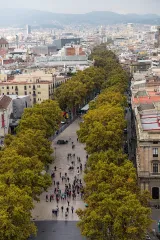
La Rambla
Squares · 45 min
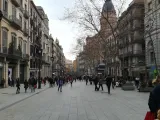
- La Rambla, also known as Las Ramblas, is a famous promenade in Barcelona that stretches from Plaza de Catalunya to the old port.
- Filled with kiosks, street performers, restaurants and stores.
- The sale of flowers began as early as the 19th century.
- Among its places of interest are: the Palacio de la Virreina, La Boqueria Market, El Liceu Theater...
- La Rambla is divided into sections with different names.
© Wikimedia Commons
Coddy games passing through
-
15
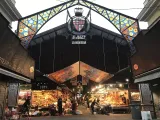
La Boqueria
Unclassified objects · 45 min
- The Mercat de Sant Josep is a municipal market popularly known as La Boqueria.
- It offers a wide variety of fresh produce and is a tourist attraction.
- Its modernist architecture is combined with neoclassical elements, such as the Ionic columns.
© Wikimedia Commons
Coddy games passing through

Afternoon
-
16
Casa Lleó Morera
Historic architecture · 45 min
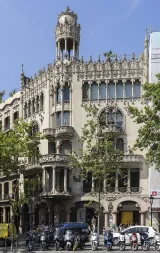
- Casa Lleó Morera is a modernist building designed by architect Lluís Domènech i Montaner, was commissioned by Francesca Morera in 1902 to renovate Casa Rocamora. After Francesca's death in 1904, her son Albert Lleó i Morera continued the work and gave the building its name.
- Construction was completed on March 10, 1905.
- It forms part of the Block of Discord along with Casa Batlló and Casa Amatller.
- It is the only one of the three buildings to win the prize in the annual Competition for Artistic Buildings in 1906.
- Lluís Permanyer describes it as "a Palace of Catalan Music on a reduced scale.".
© Wikimedia Commons
Coddy games passing through
-
17
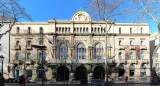
Gran Teatre del Liceu
Theatres and entertainments · 45 min
- The Gran Teatre del Liceu in Barcelona, known as El Liceu, is the oldest and most prestigious opera house in Barcelona.
- It has its own choir, symphony orchestra and a center for higher music education.
- It was founded in 1837 and opened its doors in its current location ten years later.
- The opera brought together the bourgeoisie, the nobility and the menial public.
© Wikimedia Commons
Coddy games passing through
-
18
Casa Enric Batlló
Historic architecture · 45 min
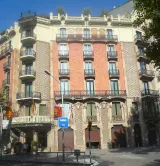
- The Enric Batlló House was commissioned by the industrialist Enric Batlló in 1891 to the architect Josep Vilaseca i Casanovas and was completed in 1896.
- Built during the modernist period, it is characterized by an eclectic combination of elements from different eras.
- In the early 1980s, the building was renovated into a hotel.
- The Hotel *Condes de Barcelona was inaugurated in 1986 and has been owned by the company General de *Relojería since 1995.
- Catalogued as Bé Cultural d'Interès Local.
© Wikimedia Commons
Coddy games passing through
-
19
Palau Marcet
Historic architecture · 45 min
- The palace of Llorenç Oliver i Soler, Count of San Juan de Violada, was designed in 1869 by Pau Martorell and Rafael Guastavino.
- In 1887, Frederic Marcet i Vidal commissioned Tiberi Sabater i Carné to build his residence, completed in 1890, with luxurious decoration.
- It had gardens, today partially occupied by the cinema and the Avenida Palace hotel, built in 1951.
- Over time, the property became the residence of the Planàs family, related to Santiago Rusiñol.
- In 1935, Josep Maria Padró commissioned the construction of the Teatre de la Comèdia, which opened in 1941, with a capacity of 1,246 seats.
- In 1960, the theater became the Cinema Comèdia, one of the main premiere cinemas in the city.
- More recently (1983 and 1995), the cinema was transformed into 5 theaters, with a main theater of 839 seats and three others with 153 seats each.
© Wikimedia Commons
Coddy games passing through
-
20
Casa Milá
Historic · 15 min
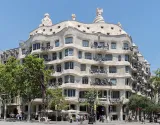
- Casa Milà, known as La Pedrera, is a modernist work by Antoni Gaudí built between 1906 and 1910.
- Commissioned by Pedro Milá y Camps and Roser Segimon, Gaudí collaborated with several assistants and a builder who previously worked on Casa Batlló.
- Open to the public since 1987, it has received more than 20 million visits, being one of the ten most visited places in Barcelona.
- It represents Gaudí's artistic plenitude in his naturalist stage, where he fuses organic forms inspired by nature with innovative structural solutions.
- In 2016, it was the eighth most visited monument in Spain, with 1.2 million visitors. Since 2013, the Fundació Catalunya-La Pedrera has been the owner, in charge of organizing exhibitions, activities and visits.
© Wikimedia Commons
Coddy games passing through
Practical details for visiting Barcelona
Where to stay
For an itinerary like this, prioritize centrality. The Born and the Gothic Quarter are perfect if you want to be close to most sights and many cafes. If you prefer to be near Modernism, look for accommodations on Passeig de Gràcia or in the Eixample, a stone’s throw from Casa Batlló and Casa Milà. Accommodation types vary: friendly hostels for tight budgets, charming boutique hotels in the Born for a local experience, and comfortable chains on Avinguda del Portal de l’Àngel or around the Plaça de Catalunya for practicality.
Expect highly variable rates depending on the season: economic (hostels and small apartments), mid-range (3-4 star hotels) and comfort (4-5 star hotels and design boutiques). To optimize, book in advance if traveling in high season or during local events. For a serene stay, choose a location that combines walking accessibility with good public transport access.
Getting around
Barcelona is ideally navigated on foot for this type of itinerary: most points of interest are close to one another. For longer distances, the metro is fast and frequent; the network covers the tourist areas and the main stops like Passeig de Gràcia and Plaça de Catalunya. The bus complements the network, useful if you’re carrying luggage or want to see the city from above. Bicycles and shared scooters offer flexible mobility, especially along wide avenues, but beware of traffic and pedestrian zones.
Walking remains the best way to feel the city and discover hidden alleyways. Remember to check the metro lines for your return trips to the accommodation, and keep a map or transit app handy. Practical: opt for daily passes if you plan several metro/bus trips to save time and a bit of money.
What to bring
Gear will depend on the season but a few essentials remain constant: good walking shoes for exploring the lanes and avenues, a reusable water bottle, a small daypack for the day, and a light jacket for evenings. In summer, bring a hat, sunglasses, and sunscreen; in winter, an extra layer and a lightweight rain jacket for occasional showers. If you plan to visit religious sites like the Cathedral of Saint Eulalia in Barcelona or the Basilica of Santa Maria del Mar, wear clothing that covers shoulders and knees out of respect.
Other practical tips: portable charger, copies/scans of your documents, a bank card and some cash for small expenses. Comfort, practicality, and adaptability are the watchwords for a successful short stay.
Advance reservations
To save time and avoid lines, book in advance the most popular visits. Skip-the-line tickets for Casa Batlló and Casa Milà are highly recommended, especially in peak season. Also consider booking popular restaurants near La Rambla and Passeig del Born for lunches and dinners, as well as any guided tours you’d like to do in museums or palaces. If you attend a show or concert, book your seats in advance to get the best dates and prices.
Finally, for logistics, plan your arrival transfer if you arrive late or have a lot of luggage. Booking a guided tour of Plaça del Rei or a thematic tour of the Gothic Quarter can also enrich your experience without wasting time. Skip-the-line tickets, terrace tables, and transfers are the priorities to book.
Extras not to be missed
If you want to stray a little from the main itinerary, here are options that add texture to the stay: wander in the Born district for its artisan workshops, go up to viewpoints for a different view of the city, or book a themed tour (photography, architecture, gastronomy). Don’t miss neighborhood markets that are less touristy if you want to feel the local life.
For a playful and immersive activity, try urban escape games by Coddy: they combine puzzles and city walks, perfect for discovering nooks while having fun. Also consider an evening tapas in a friendly bar away from tourist axes, or a nighttime stroll along La Rambla to see the city in a different light. Alternative strolls, urban games, and local workshops add a great dimension to the stay.
Local delights
The city’s gastronomy is savored at every street corner: start with a breakfast of coffee and croissant, enjoy the colorful stalls of La Boqueria for fresh tapas and fruit juices, and taste Catalan specialties in taverns of the Born and the Gothic Quarter. Do not miss the small shops selling local products: olives, cheeses, charcuterie, and artisanal confections.
For a more structured meal, choose a seafood-based menu or a shared tapas option. Vermouth bars and neighborhood cafes offer an authentic experience away from overly touristy zones. End your days with a local pastry or artisanal ice cream during walks along La Rambla or near the Plaça de Catalunya. Simple and tasty: the key is to alternate big discoveries with small tasty breaks.
When to visit Barcelona and how much it costs
Meilleures saisons
Barcelone offre des atouts toute l'année, mais le choix du moment dépend de vos préférences. Le printemps et l'automne combinent un climat agréable, moins d'affluence et des journées suffisamment longues pour profiter des promenades — parfait si vous voulez éviter la chaleur intense de l'été. L'été est idéal si vous aimez l'animation, les terrasses et une ambiance très vivante, mais attendez-vous à plus de monde et à des tarifs d'hébergement en hausse. L'hiver est plus calme et souvent plus économique ; les journées restent douces comparées à d'autres destinations, et vous profiterez d'une expérience plus posée dans les musées et les églises.
Considérez aussi les événements locaux : festivals et jours fériés peuvent apporter de la magie mais augmentent l'affluence et les prix. En bref, privilégiez le printemps ou l'automne pour un bon équilibre entre météo, foule et budget. Printemps, automne et hiver calme sont d'excellentes options selon ce que vous recherchez.
Affluence
La fréquentation varie fortement selon la saison et l'heure. Les zones autour de La Rambla, Place de Catalogne et Passeig de Gràcia sont les plus bondées, surtout en haute saison et en milieu de journée. Pour éviter la foule, commencez tôt vos visites (Casa Batlló et Casa Milà sont particulièrement agréables le matin) ou privilégiez la fin d'après-midi pour les promenades dans le Born et le quartier gothique. Les musées et attractions phares peuvent afficher des files importantes : c'est là que les billets coupe-file sont utiles.
En semaine la ville est moins saturée que le week-end touristique, et certains quartiers résidentiels restent calmes quel que soit le moment. Si vous recherchez tranquillité et petites découvertes, éloignez-vous des artères principales et perdez-vous dans les ruelles. Matinée, fin d'après-midi et quartiers secondaires : vos alliés contre la foule.
Estimated budget
- Budget travel
- Budget économique : Avec quelques compromis, comptez sur l'hébergement en auberge ou appartement partagé, repas simples (tapas, marchés comme La Boqueria), et déplacements principalement à pied ou en métro avec des tickets à l'unité ou un pass courte durée. Prévoyez une marge pour billets coupe-file si vous tenez à visiter Casa Batlló ou Casa Milà. Ce mode permet de vivre l'essentiel sans trop dépenser.
- Mid-range budget
- Budget moyen : Hôtels 3-4 étoiles bien situés (Born, Eixample ou proche de la Place de Catalogne), quelques repas au restaurant et une ou deux visites payantes avec billets coupe-file, déplacements mixtes métro/bus et quelques taxis occasionnels. Vous aurez plus de confort et la flexibilité de réserver de bonnes tables aux heures de pointe.
- Comfort budget
- Budget confort : Hôtels 4-5 étoiles ou boutiques de charme, repas dans des restaurants de qualité, visites guidées privées et transferts privés si souhaité. Ce niveau offre du temps gagné (billets prioritaires, réservations) et une expérience plus détendue, idéale si vous souhaitez profiter sans contrainte de timing.
Frequently asked questions about your stay in Barcelona
Derniers conseils pour votre escapade
En deux jours, Barcelone se révèle par fragments : une façade qui attire votre regard, une place où s'asseoir, un marché où goûter. L'itinéraire proposé vous donne un équilibre entre modernisme, histoire et vie de quartier. Ne cherchez pas à tout cocher comme sur une liste ; laissez des trous pour flâner, pour revenir sur vos pas et pour vous laisser surprendre.
Prenez le temps d'observer les détails architecturaux entre Casa Batlló et Casa Milà, de savourer une portion de tapas à La Boqueria, et de respirer l'atmosphère plus tranquille du Born. Si un lieu vous appelle, accordez-lui un moment : parfois la meilleure découverte est celle qu'on n'avait pas planifiée. Bon voyage et profitez de chaque instant dans cette ville vibrante.